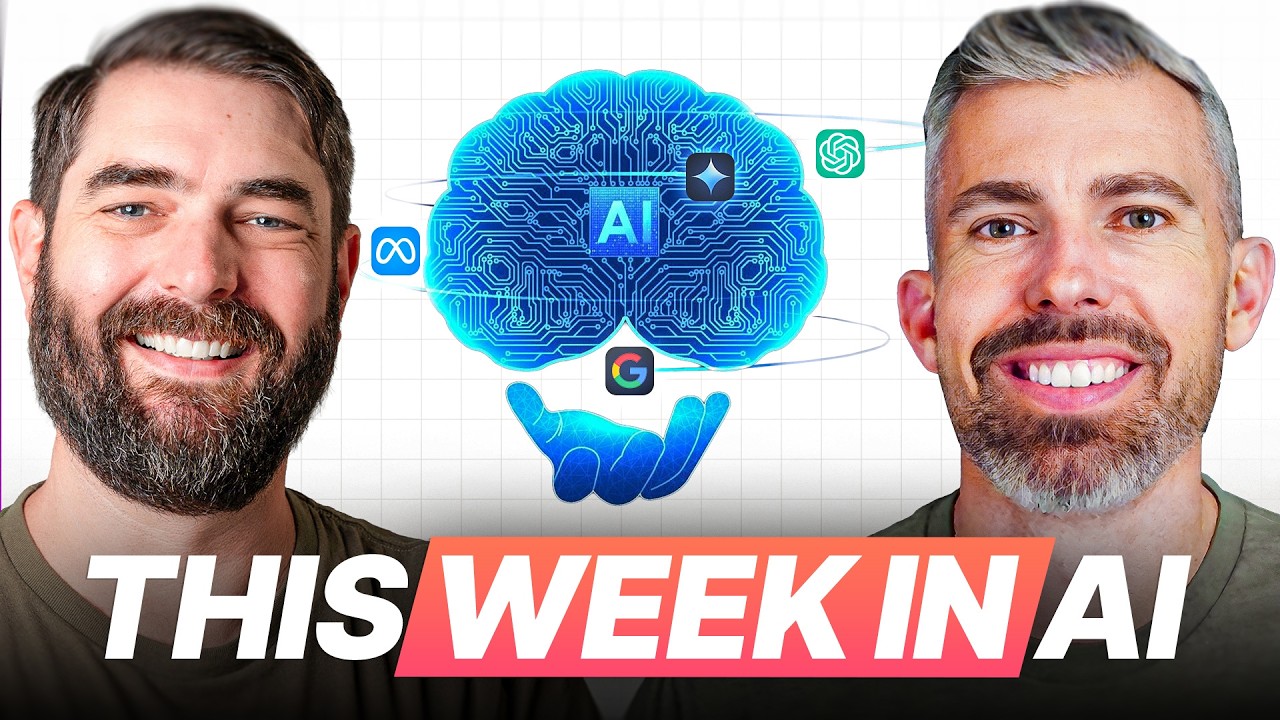








This episode is a special crossover from The Next Wave podcast, hosted by Matt Wolfe and featuring a deep-dive conversation with marketing and business expert Joe Fier. The duo breaks down the five most interesting developments in AI from the past week, with a focus on SeedDance 2.0—an advanced video model from ByteDance that’s dominating headlines for its realistic visuals and flawless lip syncing. They discuss how SeedDance is changing the game compared to heavyweights like Veo and Sora, and why its approach to copyright and training data might give it a global edge.
Along the way, Matt Wolfe and Joe Fier demo tools live, including GPT-5.3 Codex Spark and Google’s Gemini DeepThink, showing how these models can create websites, apps, and even solve scientific problems at lightning speed. The episode also explores the ethical and business ramifications of AI’s rapid evolution—from ads in ChatGPT to the potential impact on jobs and creativity—making it a must-listen for anyone eager to stay ahead in the AI landscape.
Table of Contents
ToggleSeedDance 2.0: The AI Video Model Revolution
ByteDance released SeedDance 2.0, the newest contender in AI video generation. Unlike Sora and Veo, which already impressed people, SeedDance 2.0’s demo videos stunned us. Matt Wolfe explained it’s only available outside the US for now, but promises global access by February 24th (some found loopholes, but they’ve been closed). SeedDance can generate scenes with consistent characters, multiple camera angles, and visual depth that matches top-tier video tools. The most striking feature is its lip-syncing accuracy; previous models produced uncanny, mismatched mouth movements, but SeedDance closes the gap—making it tough to spot the difference between AI and human actors. This model can even handle copyrighted characters and wild prompts, showing SpongeBob, anime, and even Seinfeld clips like real studio footage.
Key Takeaways:
- SeedDance 2.0 lets people generate multiple-scene videos with consistent characters and camera angles
- Lip-syncing matches voices to faces nearly perfectly
- ByteDance, the company behind TikTok, is “blurring the line” between reality and AI video
- Copyright rules differ abroad; Chinese models are more lenient, letting users create IP-based content more freely
Realistic AI Video Demos: Product Ads and Deepfakes
SeedDance 2.0 can create convincing product ads and user-generated content (UGC). We watched an AI-made product ad for a “stupid frog washer”—the creator uploaded a single photo, wrote a prompt, and SeedDance generated a video showing a person using the product. Matt Wolfe noted Google’s VEO model will let advertisers create studio-quality ads in minutes, with AI handling everything from images to script.
The rise of deepfake videos means viewers must now assume every video is fake until proven otherwise. Detection tools struggle to keep up, as models become harder to spot.
Key Takeaways:
- Product ads no longer need real filming; AI can simulate a person using any physical item
- Google is bringing VEO to Google Ads, opening studio-quality creative work at scale
- Deepfake realism is rising fast—assume videos are AI unless proven otherwise
- “Cat-and-mouse” game between detection tools and AI creators will never end
Useful Quotes:
“Now we’re going to live in this world where, okay, whenever I see a video, I have to ask, is this AI? Or assume it’s AI before I assume it’s real.” – Matt Wolfe
GPT-5.3 Codex Spark: Coding at Lightning Speed
Codex Spark model from OpenAI sets a new standard for AI coding. Matt Wolfe demoed its speed—building websites, apps, and games in under a minute, including a calendar app for Padres baseball games and an “epic” landing page for our podcast. The Codex model uses Cerebras chips for inference, making it respond and code with record speed. While building a web interface is fast and clean, Codex doesn’t always fetch accurate research data for apps—it needs an extra push, but handles coding tasks nearly instantly.
Codex gives control to those who want AI to do all the work, though Matt Wolfe prefers more flexibility and hands-on use with Cursor. Fast AI coding means more productivity, shorter waits, and more experimentation.
Key Takeaways:
- GPT-5.3 Codex Spark builds apps and websites in seconds
- Cerebras chips enable blazing speed for inference tasks (responding to prompts vs. training)
- Codex is the top coding model now, rivaled by Opus 4.6
- Users need a solid brief and idea to get the most from AI coding tools—“taste” and vision still matter
Google Gemini DeepThink: Science and 3D Printing
Gemini DeepThink excels in academic research and scientific reasoning. Benchmarks show it beating out Claude Opus and GPT-5.2 in math, coding, and multimodal (image or text) tasks. It scored gold-medal level on written Olympiad tests and can even generate 3D print files from sketches. Matt Wolfe demoed attempts at turning an image of a brain into a print-ready STL file, but it gave step-by-step instructions instead of the finished output.
Gemini DeepThink also solves math puzzles like the “three-body problem.” It produces Python scripts to simulate solutions and explains complex science in clear, kid-friendly terms.
Key Takeaways:
- DeepThink leads in reasoning, coding, chemistry, and physics benchmarks
- 3D print file generation from sketches is possible (with some steps required)
- Science and math tasks are handled efficiently, making it a strong tool for research and education
Useful Quotes:
“This is like insane…” – Matt Wolfe (about DeepThink’s benchmark scores)
“Imagine you and your best friend are holding hands and spinning around in a circle. The three-body problem becomes crazy.” – Gemini DeepThink (explaining complex math simply)
ChatGPT Advertising: What’s Changing for Users
OpenAI started rolling out ads in ChatGPT, especially for free and $8 Go plan users. Matt Wolfe and I discussed the shift—ads appear clearly labeled beneath answers, not baked into the response itself (for now). OpenAI’s business model depends on ChatGPT subscriptions and APIs, so ads help subsidize better models for free users. If ad clicks don’t deliver, OpenAI may make ads less obvious, following Google’s gradual blending of sponsored links with regular search results.
Google has alternatives, thanks to revenue from search and YouTube, so it won’t rush to include ads in Gemini. The change affects monetization strategies in the AI industry and could lead to knowledge gaps if only premium users get top-tier responses.
Key Takeaways:
- ChatGPT ads are shown in both free and $8 Go plans, allowing models to improve for everyone
- Ads are clearly labeled now, but may get less distinct over time if they don’t perform
- Monetization diverges between OpenAI (needs ads) and Google (supported by broader business streams)
- Knowledge democratization depends on open access; contributors worry about potential gaps
Useful Quotes:
“We don’t want to like increase the sort of wealth and knowledge gap to only the people that already have money.” – Matt Wolfe
The Great AI Leap: Matt Schumer’s Warning and the Job Market
Matt Schumer published a viral article warning that AI’s rapid progress is outpacing public awareness. Matt Wolfe and I discussed how AI can now code, reason, and even build its own next models. AI writing models are using early versions to help developers debug, deploy, and refine themselves—creating a flywheel effect for faster improvements. Schumer emphasizes that jobs relying on coding, finance, medical analysis, and customer service are now at risk. Models can build their own tools to fill gaps and iterate on past mistakes. While some hands-on jobs (plumbing, electrician, barber) seem safer, creative, analytical, and digital roles may change or disappear.
Human “taste” and creative control remain important. AI can produce drafts quickly, but users still need to prompt, plan, curate, and decide what goes live. Many underestimate how fast new models are arriving.
Key Takeaways:
- AI is building its next generations, creating exponential growth in model development
- Coding roles, finance, and service jobs will change as AI takes on more tasks
- Large language models that use and create tools mark the next leap toward “AGI”
- Human skills—taste, vision, hands-on work—are still relevant, but may shrink in scope
Useful Quotes:
“If it can happen to me, it can happen to you. This isn’t theoretical. This is happening right now.” – Matt Schumer
Key Links and Resources
- The Next Wave Podcast: https://www.thenextwave.show
- Matt Wolfe: https://www.youtube.com/@mreflow
- Seedance 2.0: https://www.seedance.com/
- ByteDance: https://www.bytedance.com/
- CapCut: https://www.capcut.com/
- Veo: https://deepmind.google/models/veo/
- Runway: https://runwayml.com/
- ChatGPT Codex: https://chatgpt.com/codex
- Matt Schumer’s Viral Article: https://www.mattshumer.com/blog/ai-changes-everything
- Super Bowl Claude Commercial: https://www.anthropic.com/news/super-bowl-ad
Conclusion and Top Highlights
SeedDance 2.0 marks the next leap in AI video generation, closing the realism gap and enabling anyone to make nearly flawless content—ads, skits, explanations, and more. Fast AI coding means app ideas turn real in seconds, leaving the bottleneck at the planning stage. Google’s Gemini DeepThink tackles science and math, providing kid-friendly explanations and powerful computation. ChatGPT’s ad rollout signals shifts in monetization, balancing democratized access with the risk of knowledge gaps. Matt Schumer’s warning reminds us that AI is accelerating on its own, bringing jobs and creativity into question for everyone not paying attention.
Paying attention is now more important than ever. Anyone using AI tools should focus on their ideas, creative vision, and the human touch. Technology is moving fast, but good taste, clear prompts, and smart planning still set winning projects apart.
Stay curious, stay aware, and keep hustling along with the Flowchart crew—AI is changing everything faster than most people realize, and there’s still plenty of room for those who know where to look and how to use the best tools.
Two Other Episodes You Should Check Out
- The Next Wave – Why Your Next Phone Call Might Be With an AI Clone
- 99% of Small Businesses Will Die Without AI in Four Years! – Brad Hart
Connect with Joe Fier
- What if you could have a FREE personal mentor on-demand?! With Joe's Hustle & Flowchart AI clone, you can tap into the knowledge from over 600 episodes any time! Whether you need advice on scaling, marketing, or productivity, my AI clone is here to help.
- Want us to build your clone for you? We’ll handle setup, testing, and integration so you can launch fast. Head to HustleandFlowchart.com/interest to get started!
- Hubspot has launched a whole new suite of AI Tools, check them on the Hubspot.com
- Check out other podcasts on the HubSpot Podcast Network
- We want to hear from you. Send us the One Thing you want to hear on the show.
- Connect with Joe on LinkedIn and Instagram
- Subscribe to the YouTube Channel
- Contact Joe: joe@hustleandflowchart.com
Thanks for tuning into this episode of the Hustle & Flowchart Podcast!
If the information in these conversations and interviews have helped you in your business journey, please head over to iTunes (or wherever you listen), subscribe to the show, and leave me an honest review.
Your reviews and feedback will not only help me continue to deliver great, helpful content, but it will also help me reach even more amazing entrepreneurs just like you!